
Look at that- a car reflection driving right across my artwork! Seeing my work through a gallery window inspired some thoughts on reflections and realities. I wrote about it – OUTSIDE LOOKING IN -on my blog here: bobbibaughstudio.com/blog
Read More
Talk it through… “Someone who has found a process”
I like to talk. Generally, I do not find it scary. But this weekend on DeLand’ Studio Art Tour, I re-discovered some wonderful things that happen when talking specifically about my own artmaking.
Clarification. Refining. Deepening.
In addition to friendly chats and welcomes to my studio, I had the chance to engage in some great conversations about the series I am beginning now: the meanings of home, as represented by shapes of houses. I have done a lot of thinking abut this already, as part of my own personal journey. But, as I answered questions and described the processes (both the technical how-to processes and the sketch-to-art thinking process,) I was able to enrich my own thoughts. The very experience of the talking deepened and improved my own understanding.
Poet William Stafford describes poetry in a similar way, and I love this:
'A writer is not so much someone who has something to say as he is someone who has found a process that will bring about new things he would not have thought of if he had not started to say them.'"
Things I would not have thought of till I started to make art about them.
The creative process is an experience with many levels. One of the great realizations about this discovery is that we don’t have to have everything all figured out before beginning. We can begin. We can listen to the work. We can talk about the work. And all of that becomes part of our own understanding.

Work-in-Progress… Row House Neighborhood
I grew up in Baltimore. When I was born my family lived in a row house. Our car was parked on the street out front. In the back, little identical yards opened onto an alley, the place for riding bikes and playing catch.
My parents longed to move across the main road to the neighborhood of individual, non-attached houses. Each would have a driveway. Each would have its own backyard. There was a neighborhood school. The houses were mixed styles: brick, stone, clapboard, almost all two story, facing streets lined with maple trees.
This was the post-war dream, and they believed in it completely. A family started in a row house. Then they moved to the better neighborhood.
When I discovered a photo of a row house neighborhood, I was filled with affection for the families living in them. I wanted to create a warm vibrant depiction of the neighborhood. In my completed work, the people will not be visible. But they will fill the scene. The houses are alive with pattern and energy just as the actual houses were alive with the real aspirations and dreams of their inhabitants.
Creating image of homes – homes that evoke memories, and homes that allow us to peek inside the windows to imagine the lives within, are continually fascinating to me.

Once She Could… take a look and let the poem tell the story
This textile collage was juried in and will be headed to Woodstock, Illinois to be part of the 31st Annual Women’s Works exhibition at Old Courthouse Center. It’s a fine art exhibition of work in all mediums.
As I packed up the piece in its shipping box today, I spent some time looking at it more closely. There’s a lot going on in it, and I remembered both the memories and meanings I put into it and the technical process of making it.
I have created several works featuring a young girl depicted as a black silhouette. It evokes memories of a paper doll and, without specific features, has universal appeal. Here she’s writing at the blackboard. Writing, drawing… what? I feel her reaching on tiptoes to complete the image. (Having always been among the shortest in class, I relate to this.) Rather than place her in a physical, recognizable schoolroom I have suggested a blackboard, and created an otherwise dream-filled environment. There is soothing water with tree reflections. There are tangled roots. There are blossoms on branches, loosely connected to what she is drawing on the blackboard. There are blocks of non-representational color and texture. Whatever this environment is, it is complex. I want to draw the viewer in to taste some of the forces and feelings that are part of her world.
As I created the piece, words for a poem were in my mind. I did not write the whole poem till after the work was complete. I was an elementary aged student in years when girls were not taught or encouraged to think about their potential or their possibilities. This sense of entrapment is part of what I was feeling as I created her environment.
The collaged layers make this work almost rigid, although it is fabric bound and backed as an art quilt. I used gel medium photo transfers of original photos onto muslin for the water, the roots and parts of the branches with blossoms. Other areas use monotype printed textures, stencils, direct painting, and varied patterns of machine stitching. The backing is hand painted muslin in colors to match the work.
I love this little girl. I fin myself thinking about her and all she might be. Girls should not feel trapped, and – like imagined characters they draw – they should soar!

One thing leads to another...
A bee becomes a bird becomes a fish…
The work of MC Escher always provokes amazement and wonder. How did he do that? How did he accomplish his transformations with such incredible detail? What cerebral mix of mathematical and artistic interest works out over and over the intricacies of perception, perspective and transformation?
DeLand’s Museum of Art is currently hosting a wonderful collection of Escher’s prints. Some are lithographs. Most are woodcuts. All are exquisitely detailed and planned. After leaving the exhibition, I called the images to mind, remembering the patterns and images that most stuck with me.
His use of color is especially intriguing. Many of the works are black and white. And many appear to be black and white but actually have a very subtle hint of color imprinted from a second block or a second press hit. Such beautiful greys! I found myself in my studio looking at my color wheel, finding the greys and thinking about how enriching they are.
And the simple idea of transformation. There is nothing simple about the execution – they are breathtaking in their detail. But the concept is simple and compelling. One thing becomes another. Then it may change back into what it was. Or it may become a new thing.
To artmakers, this is a studio reality. One process leads to another, which may open up a new door, or may lead on a path back to the original way of working. Things change. Ways of working change. How interesting, how interwoven it is.

The magic that occurs during a studio visit
I’ve just been working on some promotions for the upcoming Studio Arts Tour in DeLand. It’s caused me to remember some of the visitors I had last year, and why it is so important to me to show people what I make and how I make it.
I remember several times last year when I had as many as fifteen people at a time in my tiny studio. (I’ve moved since then, and there’s more room.) The visitors had such great questions! I was working on a large fabric-pieced quilt the weekend of the show. Since it was in 6” squares, it was easy to keep busy in between visitors. When guests arrived, I was either collaging pieces on the small squares, or moving the squares around my worktable to develop the composition of the piece. Things that I take for granted are really interesting to studio guests. What kind of glue do I use? What kind of paint? Why do I choose certain colors? Where do I get my ideas? Every question caused me to think through my process so that I could supply a meaningful answer. It became a process of clarifying my own work. I was so grateful for the attentiveness and interest of those who visited.
I had some great experiences like that during outdoor Festivals last fall. I especially enjoyed several visiting groups of students. What great questioners they were! They went straight for content. They wanted to know about meaning, and the symbols I use, and whether I draw on stories or mythology. A few had been in art class enough to know terms like value, balance and contrast, and we had good discussions about those elements in my work.
So… I’m getting ready! I always enjoy showing art, and I really enjoy selling art! But even more, the tour will be an opportunity for me to think about my own artmaking. I can’t know in advance what thoughts I’ll have. But my visitors will guide me!

Life Lesson: Artists know there’s more to work than what you learn in school
My undergraduate art degree simply did not include power tools 101. But an artists-as-entrepreneur learns what every other kind of entrepreneur learns. Sometimes you’ve just got to do what needs to be done. Today, it’s sanding and painting frames. Not creative. But part of the process. And, as a change from my usual artmaking routine, a very pleasing task.
If you ever review a resume and see “independent studio artist” as part of the work experience, this should go in the “plus” column. Studio artists need to be problem-solvers. We need to be self-motivated and self-directed. We need to work under deadlines. We need to balance long-term projects with immediate concerns. We take pride in our work. We have, almost always, experienced failure, and learned from it. We need to understand budgets and product pricing. We need to be good researchers, studying art history, contemporary trends, materials, our competitors, gallery opportunities and sometimes even glue adhesion properties. Many student artists are both right-brainers and left-brainers: envisioning and creating the product, and then doing the marketing, bookkeeping and inventory associated with it.
Like most stereotypes, “artist-as-flighty-snowflake” is a myth. We work hard at what we do.
And, of course, sometimes we get to play with power tools!

BOREDOM? REALLY? YOU GOTTA-BE-KIDDING-ME
Recently I heard a radio story about experiments in boredom. The premise was astounding to me. Two reporters were to begin the bold experiment (could such a thing be possible?) of turning off the cell phone and stowing it away for twenty minutes at a time. To experience boredom. Because not being on the phone is equated with being bored.
Really? Is this real? The word one should use to describe not being plugged in to continuous texting-gaming-digital-socializing is “boredom?”
Whatever hours I find to be unplugged and quiet are cherished. It’s when I am most creative and productive. Working in quiet allows rhythms and patterns to merge in my thoughts and in my artmaking. In the same way that brain-while-sleeping is creating and rearranging through dreams and memory storage, it feels like my brain-while-awake-but-quiet operates on a different level than when I am plugged in and distracted.
To me, it’s absolutely essential. And I believe this may be one of the great offerings artists can give to the rest of the world. I know that all artists don’t go about their creative work in the same way. But all of us incorporate some conscious time of creating and dreaming as a stage of our work. It’s not useless unfilled time. It’s at the core of the work.
I was not surprised that the radio reporters found that they liked their “boredom.” One rode the subway, observing and wondering about at the people around her. One unplugged while walking several blocks to an appointment and experienced the sounds and sensations of his own body in motion.
It sounds to me like the beginning of creativity, the genesis of art.

Through the door of a question…
Good questions don’t close the door. They open it.
To look at a thing – a scene – an event, and to ask questions. To wonder what is really going on, and when it began. What an entry into mystery.
This evening I was reading the poem “December Moon” by Mary Sarton. She looks out her window at snow on the ground, pristine and untouched, and then again in the morning, when the surface is criss-crossed with the tracks of animals. She allows the observation of change to conjure questions and images. “How much can come, how much can go when the December moon is bright, what worlds of play we’ll never know.”
And, reading, I became caught up in the wonder too. I could imagine foxes dancing. Cats tiptoeing. Small birds almost skating on the surface, leaving just whispers of markings. Who knows what went on by moonlight?
I love this quality of poetry. I love the way a poet can begin with a simple observable object or scene and open it up for examination, turn it over to reveal possibilities, then look beyond the thing itself to suggest other deeper meaning. I try to bring this process into my own artmaking. Not living in a snowy place, I am drawn to water, shadows, looking underground, under rocks.
I think I’m closest to getting it right when I can create an image leading a viewer to the door of questions. Then living with the work becomes a process of considering possible answers.
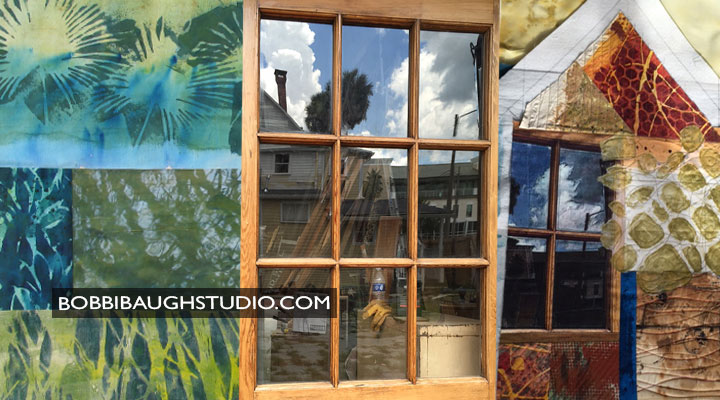
What’s the same… What’s Changing? Seeing Ideas Evolve
I spent some time today looking through collected images of my own work. It’s a good exercise – much like looking back through my sketchbook at ideas I had cooking for awhile. But, when I review completed work, I begin to see patterns.
First of all – just to get past this – it’s very humbling. There are a fair amount of things I just don’t like anymore, about which I wonder, “What was I thinking?” OK. The only way never to fail is never to make anything. So I try to accept the ones that don’t much please me.
But “What was I thinking?” may be the exact right question. What impulses have I seen re-emerging throughout my artmaking? I have been working consistently In textiles since about 2010, experimenting with printing and construction techniques and subject matter. With so much variety, is there some common element?
I think so. And it helps to find it. In some way, an interest in surface vs inner has been what interests me. Sometimes, it’s taken the form of landscape explorations, where I’ve tried to see above ground and below ground at one time. Sometimes it’s been in the form of memory pieces, where I have scratched the surface of my own life, digging into issues of outer appearances compared to inner realities.
For 2018, I am focusing on a body of work developing images of little houses. I will fill them with patterns and windows into the inner life, with the shape of the house indicating what’s seen from the outside. I am very excited as I look at the new sketches and mockups, and interested to see how this all evolves.

Four Lessons from collaboration: an art-for-the-bees weekend at Stetson University
Creating images of giant particles of pollen – together!
First I had to clear my head of the déjà vu. There I was, in the drawing classroom of Sampson Hall, looking at the same plaster busts I had drawn as an undergrad forty two years ago. (I believe the drawing benches are the same ones too!)
Along with six other textile artists, I was part of a three-day workshop in screen printing under the guidance of Stetson’s visiting teacher/scholar Madison Creech. Madison taught us a registration system using a pinned thread grid, and printing techniques using thickened dyes. Our studio practice allowed us time to work on individual projects for a full day, learning the feel of the squeegee and the peculiarities of the printing medium.
But collaboration was our primary project. It began on workshop day two. Artist Jessica Rath will be visiting Stetson in late January with an exhibit that will submerge visitors in the life of bees. “A Better Nectar” will be a multisensory installation exploring the subject of buzz pollinators. The project bridges the worlds of art and science and will have displays in the Hand Art Center, the Gillespie Mineral Museum and the Science Department in Sage Hall.
Our task was to create three floor-to-ceiling banners depicting an explosion of pollen. We printed beautiful panels of deep purple silk with a discharge (bleaching) medium that removed the purple dye, creating images in white. Working outdoors to disperse the strong fumes from the discharge paste, our group learned these lessons:
Group work is fundamentally different from solo work
It felt like a switch in a different part of my brain was turned on. My regular studio practice is completely self-directed. This process involved listening, allowing ideas to evolve as a group, being open in different ways.
Group work becomes a dance
As we worked our way around long printing tables, we literally weaved in and out of one another, reaching into a space to print, stepping over electric cords, pulling back to wait for a space, all while keeping an eye on one another and the image being created.
Group work creates momentum
Things began to build. One idea led to another in an organic way.
Group work is exhilarating
There’s not much chance for high-fiving or saying “way to go!” when working alone. Encouraging the input of each other as we printed created a natural sense of enthusiasm.
Group work creates bonds of respect and friendship
The other artists thought of images I would not have thought of on my own. We grew in appreciation of each other’s ideas and enjoyed the shared creative experience.
Going back to school provided great lessons.
More about Rath’s bumblebee-inspired work here:
jessicarath.com/info/
More about the upcoming Jessica Rath exhibits at Stetson:
https://www.stetson.edu/today/.../jessica-raths-a-better-nectar-exhibit-to-visit-stetson/

Being a Citizen… From Inside my Art Bubble
This morning in the studio I was sewing on a new art quilt with NPR news on in the background. As I stitched, I thought what a strange juxtaposition this was. Here, in my self-contained world, in a room in which I have a fair amount of control over outcomes, I am creating. Meanwhile, stories that are big and important, over which I have very little control are unfolding and being reported. Meaningful immigration debate has evaporated – at last for now – in a slew of ugly, racist words by the President. Other countries are reacting. A US ambassador has quit in protest. And the list of important issues facing our country remains a large stack of untouched “to-do’s” in the congressional inbox.
And I am merrily sewing along.
Each of us, as we go about our chosen work, is faced with this same juxtaposition and decisions about what to do.
After setting up this situation, I realize, of course, that I have no magic answer or prescription to offer. Living in a complex world is hard. Living in a country that allows tremendous freedoms along with tremendous responsibilities is hard. It is tempting to retreat entirely into the bubble of what I can control or what I enjoy. But it’s not a solution that would be right for me. Living so deeply in the world of external events that I become unable to create artwork would also not be right for me.
For now, I do what I believe most caring, thoughtful citizens do. I engage in the greater world to the best of my ability: as a volunteer, a giver of what money I can donate, a voter. And I continue to create work that is meaningful to me.
Is it enough? I feel the need to keep asking that question.

Just one more reason (of-oh-so-many-good-ones) to take the road less traveled
To see what you can see. To discover what you would have missed. To avoid the maddening traffic and congestion of an Interstate highway. All are good enough reasons.
And sometimes, as in my recent drive through rural South Carolina over Christmas vacation, there will be a rare gem. There by the side of the road, tucked back among pines, I found this abandoned home. Those words are the stuff of storytelling. Why was it abandoned, and by whom? How long has it stood in this form? In what stages has it fallen apart? My crunching steps in the thick pine needles were the only sounds in that still place. Like most of the roads we travelled on this trip this one had very few cars and no trucks.
Houses are my artmaking focus this year. The simple shape of a rectangle plus a triangle for a roof contains lifetimes of memories and associations. The simplest drawing made by a child, showing a house with a little family beside it or in it, is rich with meaning. The outside of a house and the world it contains can be very different. And windows are wonderful points of entry from the outside to the life within.
I was stirred in m own memories standing in the quiet place by this house, this structure that used to be somebody’s home. My photos will be a way to remember, as well as a source of images to transfer to fabric and incorporate in my collaged work.
Our South-Carolina to Florida trip took at least three hours longer than the most direct driving route. For me, it was a good use of time.

SEEING… by hand
How to begin to interpret a pollen spore? It’s a foreign object, like an alien being. And round. It’s hard to know where to begin. That’s where a little simplified interaction with my sketchbook started the process.
Read More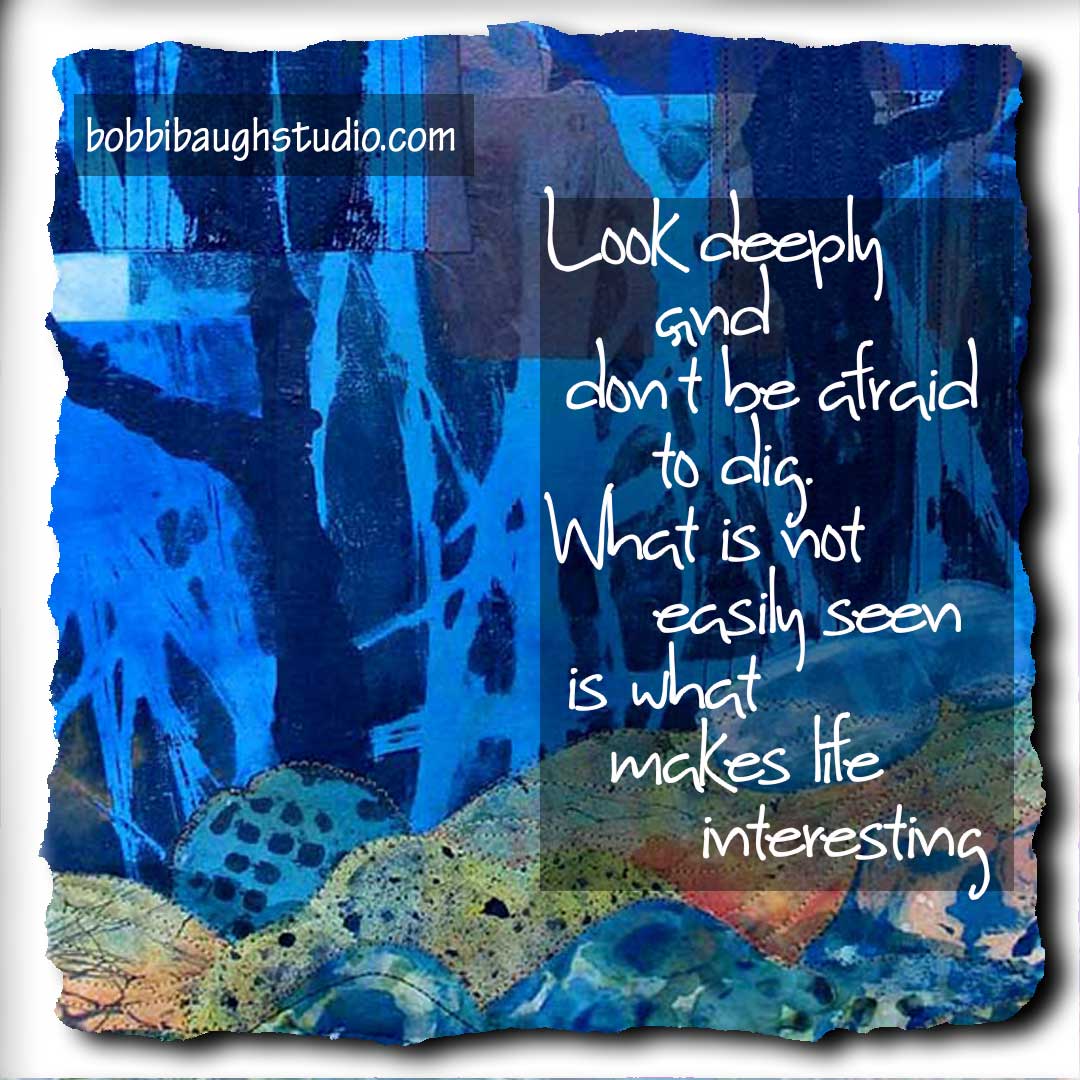
Look Deeply and Don't Be Afraid...
TBT... I enjoyed rediscovering this image today. I created it in 2017. (This is a detail of a larger work, “Are You Really Up There Mr. Moon?”)
The process of creating the tree layers was, itself, an exercise in looking deeply and not being afraid. I remember that I had started with the deep blue painted background. I just loved the patterns I had built. But it did not do what I needed in the piece—I wanted to create a dream-like landscape. So I had to do the thing that I find scary. I had to mess with an image that I liked, not knowing if I would ruin what I loved and not knowing if it it would go where I wanted. So I just kept printing and collaging. As the work evolved, it did create exactly the effect I had hoped for.
The finished piece found a home with a collector — always the best possible outcome! And, I also submitted this image to the public art project in DeLand to be digitally printed on an large utility box. It now graces a corner under the trees. I can drive by and see my artwork out in the big wide world!
The process wasn’t easy. This piece took unexpected turns. It required me to get over some inhibitions. But, in artmaking -– as in pretty much any other endeavor— that’s what made it interesting.

Is Juggling a Good Idea?
For me, in the studio, I believe the answer is yes. I looked around this afternoon. There are at least five projects working. One on the easel is one in the midst of collage layers. One is a sketch tacked to a board. One is in pieces by the sewing machine ready to stitch. One is nearly finished and awaiting hand stitching of the binding. One awaits a fabric-painting session, which I am putting off till I have a few hours of sun to paint outdoors.
I love the energy of multiple projects in the works. Perhaps it’s because I feel good about the source of these works. I’ve been sketching and thinking and composing a series for awhile, and I am now in the process of creating the work. So I am watching the ideas unfold. I am using the quiet time of hand work to think ahead about the next piece. I am allowing the movement back and forth between works to keep the whole process alive and interesting.
It’s not really so much like juggling. It’s more like a dance – an old-time reel. Moving in a patterned way from one partner to the next, coming back to the beginning, moving in a new way, then over again. The studio dance.
Last chance – last dance - new creating – no mugwumps
The rhythm of artmaking and life as a human being feels just about right today. The day is cold and drizzly – about as much experience of winter as we get here in Central Florida. The newspaper is full of taking stock, putting aside and looking ahead. A local sports team is ready for last game – last flame – last chance – last dance. (Who new sportswriting could be so poetic?) Merriam-Webster announced its word of the year for 2017. (“Feminism.” But has that not been important for quite some time now?) And words the language analysts are eager to put aside. (“Fake News.” Amen to that one. And “drilling down.” Also Ok with letting that one go.) I’m a little disappointed to see that “gauche” and “mugwumps” are no longer useful and fashionable. I especially like mugwumps.
And in the studio… what I needed to happen over the holidays has happened. I put all my work aside for a bit. Then I completed some works that have early-2018 deadlines. My worktable is cleared for new creating. I have revisited my sketchbook, worked out ideas on paper and in Photoshop, and I am full of new plans for artwork that interests me. For me these dance steps of change are necessary and pleasing. OK 2018. I’m ready.
May what you need and what you hope for be yours as well this beginning of 2018. Happy New Year.

Right by my Studio WIndow... inspiration for a poem
The Appropriate Name
The motion called to my attention.
On the lawn, something happening.
Staccato motions, flurries of dark spots.
Music notes.
Leaning my chin on the sill inside the glass,
Nose just below the edge of the blinds,
A horizontal slice of life beyond.
And robins.
(Fat red robins. Infrequent. Wondrously arriving in unexpected flocks.)
So close… oh they were so close!
Close enough to know each one, each this-is-who-I-am,
and to name them.
Miss “I-was-here-first-in-the-birdbath” and you just better get on your way.
Shoo! Mine!
Miss “C’mon-it’s-my-turn-now” and I’m just going to flutter my way right in there.
Not to be.
Did I say how close they were? So close.
Close enough to see the brightness of their eyes.
Close enough to feel, in the dark space behind my eyelids,
stroking those soft feathers.
Close enough to wonder.
Where do they hide the hours when not in my birdbath?
How did they choose this yard, our yard, to be their landing place today?
Today. Maybe I should mark it on my calendar
as the day I saw and named the robins,
the day my who-I-am became
crazy old namer-of-birds-woman-at-the-window.
Or the day I remembered being young and small
and entered a world of wondering and writing,
of giving voice to musings on little birds.
And stopped. Took Time. Watched. Saw.
Whichever name is appropriate.
Did I say how close they were?

Side-By-Side
As I sat by my booth at the Arts in the Park Festival in Blueridge Georgia last weekend, I thought I felt somebody’s breath on my neck. I felt her little presence. So I turned my head slowly. “Hello” we each said.
Barely five years old was my guess, and we never exchanged names. She is an artist too. She told me. Watching me practice sketch with some loose left-hand quickies, she thought my art looked a little funny.
“Well, how about the finished pieces I have hanging in my booth. Do you like those?” Like a good critic, she took her time looking them over. (Although most critics do not add pirouettes and twisting dance moves as she did.) “Yes.” She said my work was nice.
I asked her which one had her favorite color. This was a big decision, because her favorite color is turquoise… no, red…. no, yellow. She has a number of favorites. Finally she pointed to what she liked most in my work, and came back over to my sketchbook. She said she liked to draw too. So, of course, I handed her the pen. Right next to my work she added hers — with a little coaching. She said she didn’t draw humans very well. So I suggested she start with just a head. That made sense. Then I suggested adding a body. And some legs. And she did.
Then her Dad reappeared from his visit to the booth next to mine: a chance to show her work and explain about the art we’d been making.
So much good in such a short encounter. My memory of her sweetness. Her confidence. Her little dance. That she knows of wonder. That she likes to create.
I have thought of her all week, wishing stars and stars for her.

Expectations; Small and Otherwise
This was the beginning. In so many ways.
Two little girls sit on the front steps in their Sunday best. I’m on the left with the Buster Brown haircut. My sister has the curls. I remember wearing those dresses because of the scratchy crinoline where the petticoat attached at the waist. I remember the steps of our row house, my first home. I remember the sense of expectations. Little girls were expected to dress and act in certain ways. Family life was expected to include certain rituals and roles.
Looking back, I see those expectations being very small. My memory of the time combines with my understanding of life as it unfolded in the work shown, “Small Expectations.” A digital transfer of the photo from my family scrapbook, altered, is at the center. In the background I transferred text from a book on etiquette for young girls – prescriptions and externally applied expectations. The girls are surrounded by elements of childhood and innocence: blocks, an alphabet, variations of primary colors.
The little bird in the jar appears in the scene. A recurring symbol in my journey pieces, the bird appeals to me as a character. I like the inquisitive cock of her head. I like her character, a pudgy little body upheld by spindly legs. I can envision the hop and peck of this little bird, the constant quest for nourishment played out in a jerky little dance. She is all potential unrealized. She has the capacity to fly, but, for now, is still grounded. She does not belong in a jar.
I am volunteering in a first grade classroom this year. The capacity to fly is in each child. They are so beautiful that I look at them and blink back tears of amazement. I want their expectations to be unlimited. I want them to think that anything is possible. I want the adults in their lives to tell them that it's so, and to guide them to those possibilities. I want them to be creative and weird. I want them to take flight. I do not want them to live in a jar.