Last week I was drawing the boat for my “family-in-the-boat” quilt.
This week is what happened next after the drawing, plus a few simple surface design experiments to create the wood.
At the end of last week, I was here: a sketched boat on kraft paper, enlarged (using a grid) from my smaller reference drawing:
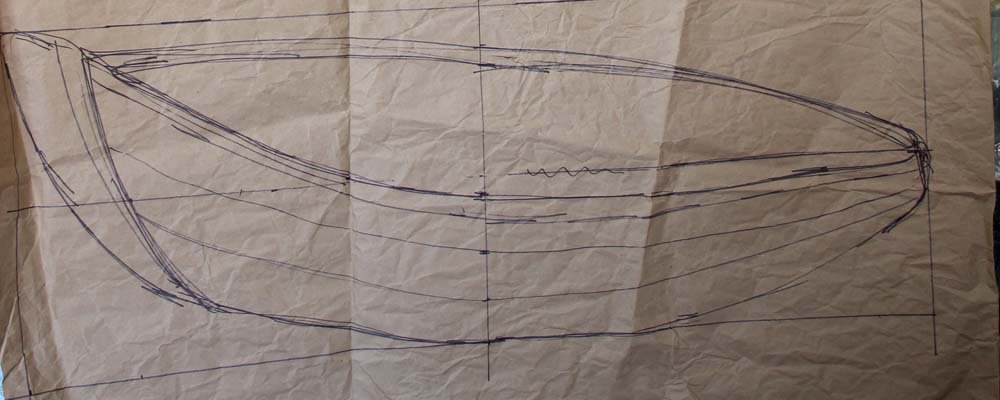
Now I would cut that drawing into pattern pieces to sew back together again to create the boat from fabric.
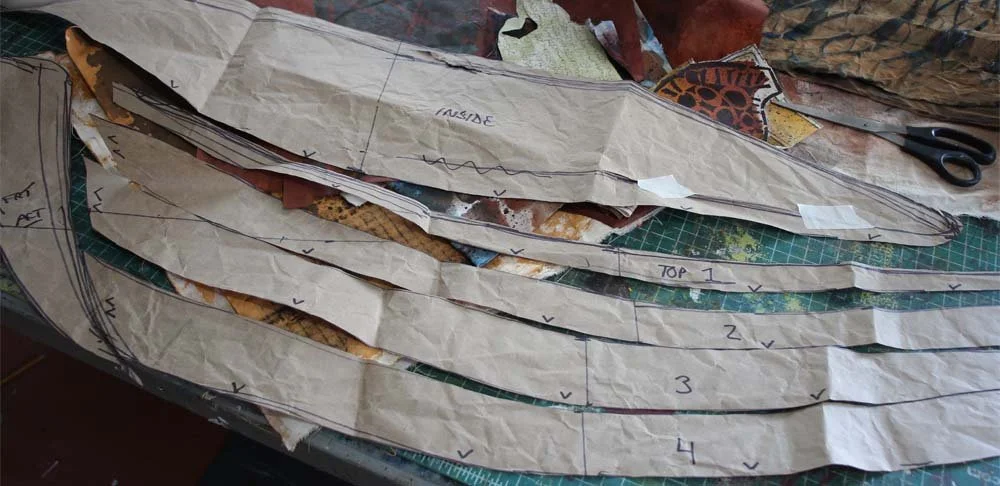
I had painted about two yards of muslin in brown washes a few weeks ago, thinking at the time that it would be sufficiently interesting to use as-is.
Now, turning back to it, I thought, “Really? What was I thinking?” It was pretty boring.
To have more interesting brown fabric, I went first to my fabric stash to see what I might find. I like how these colors and patterns look together.
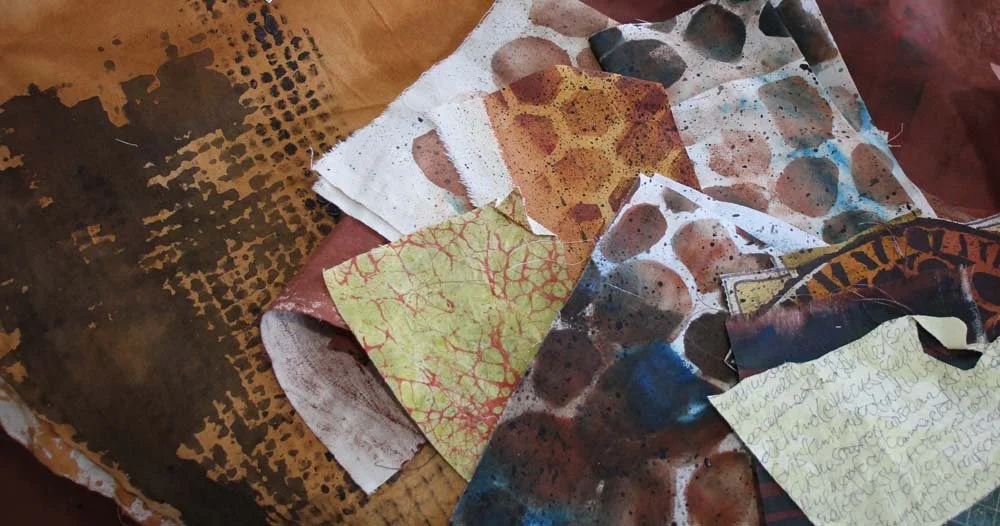
But, except for the piece on the far left, they connate rocks or seeds more than wood. So the stash would not be my fabric source. I’d have to create something new.
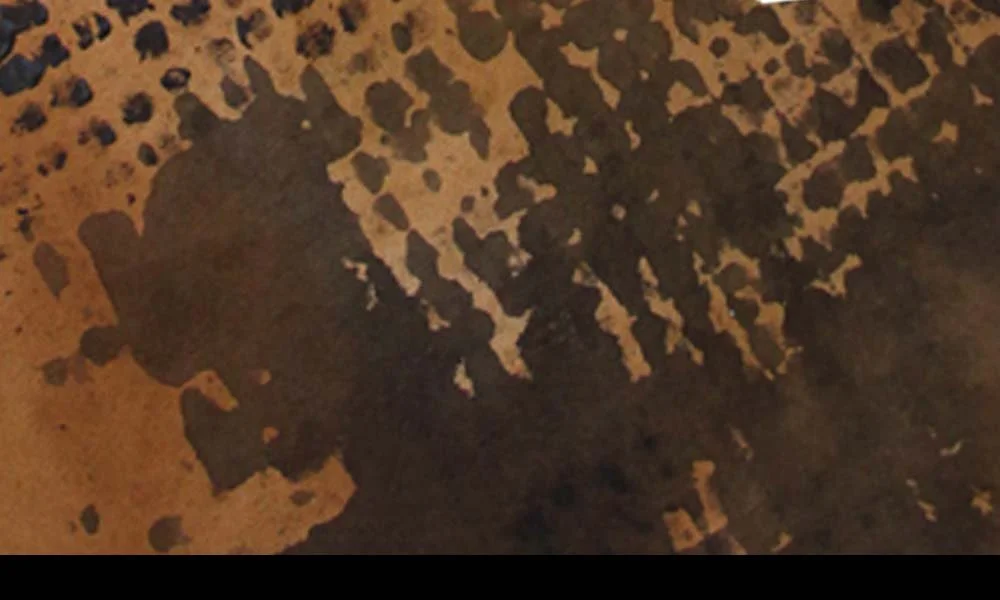
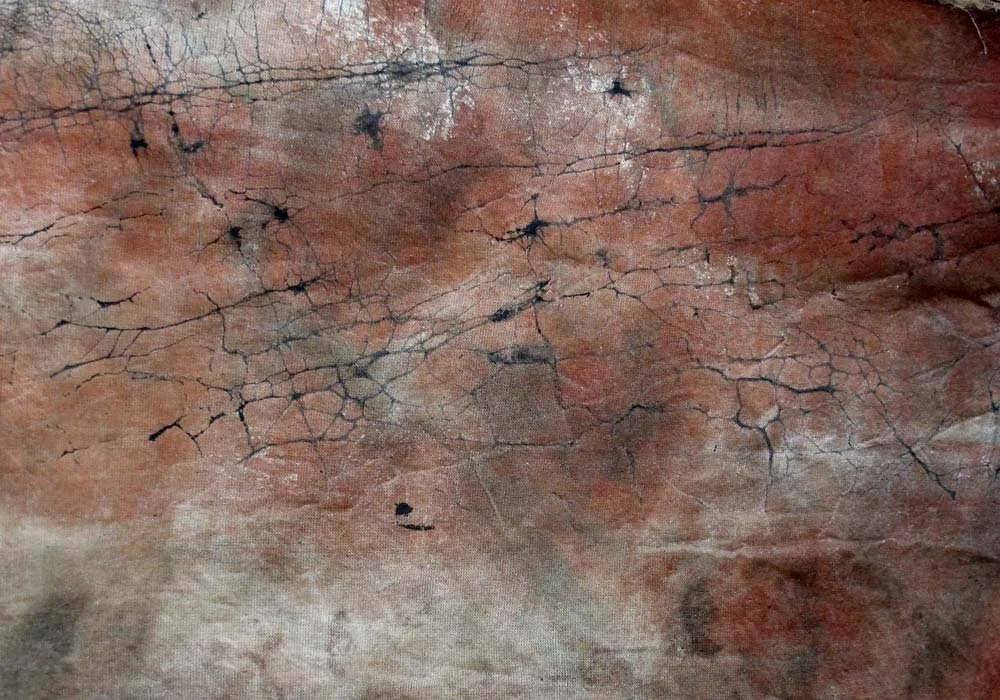
I had a little wheat paste left over from another project and decided I’d add crackle to my not-very-interesting brown fabric. I like this much more:
Then it happened I was at an art event having a nice conversation with an artist who works with indigo dyes and shibori patterns. The process involves folding and tying fabric in particular patterns then immersing it in fabric dye. They were lovely.
I remembered one of the sentences I read in a surface design book around 2010, a self-guided study that changed everything in my artmaking. I circled the words in red and highlighted them with great big asterisks. It said “Generally, any surface design technique done with dye can also be done with acrylic paint.”
Ting! Lightbulb moment.
I knew I would not get the full shibori patterning using the heavy cotton fabric I had in mind, and that was fine. I am looking for that beautiful characteristic shibori patterning of waving parallel lines.
I had seen an online tutorial some time back about scrunching and painting. I gave it a try: My fabric cut to a long, thin rectangle (which worked because I was going to cut it out for my boat pattern pieces) with the width about the circumference of a 4” PVC pipe I found. I wrapped the fabric around the pipe, tied it with twine by wrapping all up and down the length of the pipe, then scrunched the fabric down to about half its original height, then wrapped the scrunched piece.
Then I spritzed the whole thing with water, then painted it loosely with a darker brown and some splashes of blue. Let it dry. Open – unwrap the twine. The result:
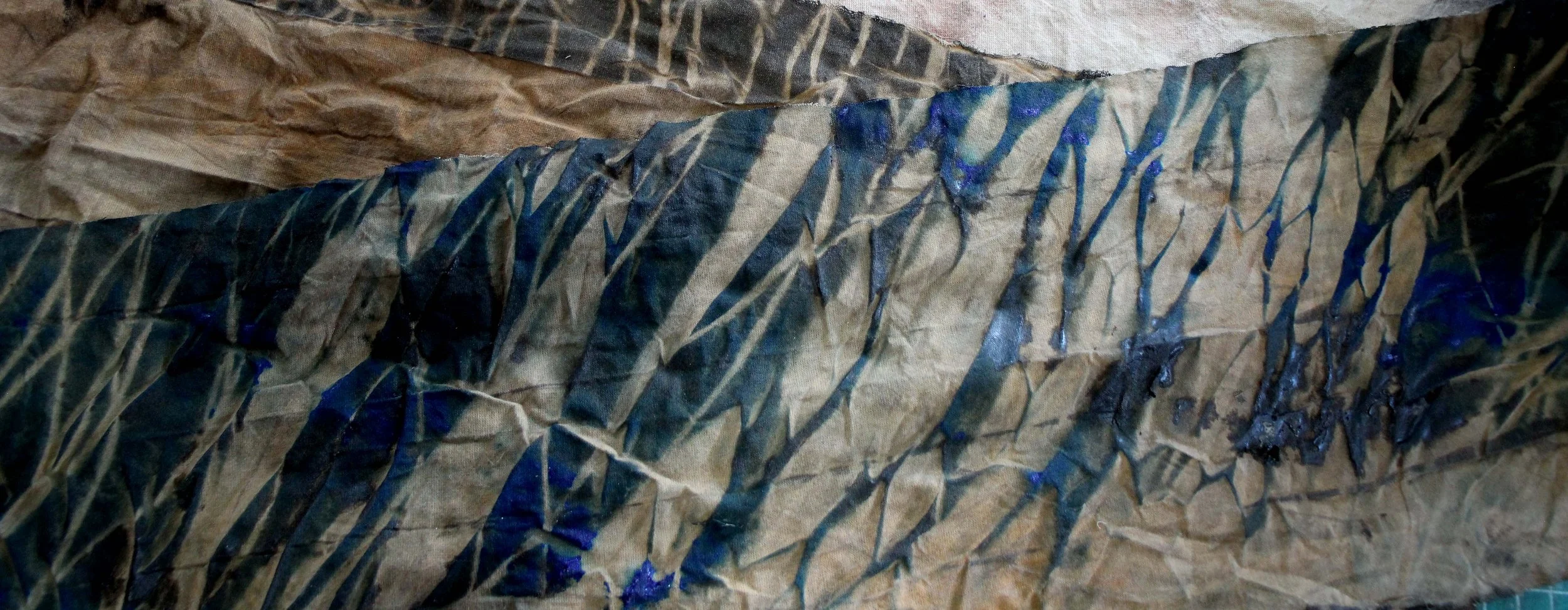
Between the wheat paste crackle, one piece from my stash and this newly printed piece, I had enough to put together a more interesting boat.
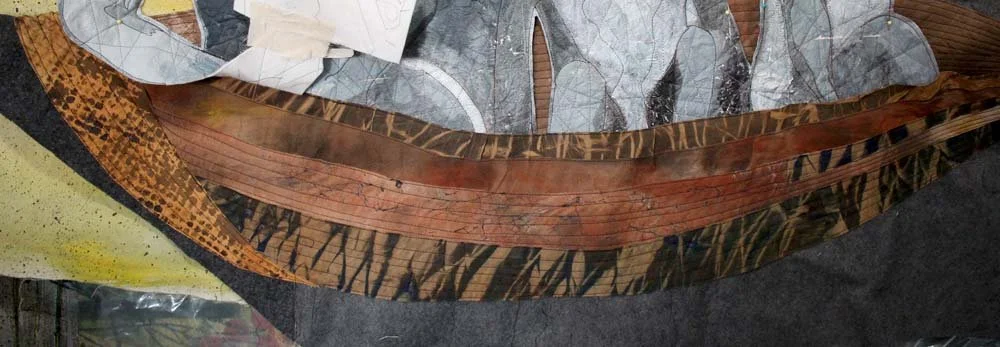
See the family just peeking into this photo, placed into the boat? They are coming along too, and the work is becoming more and more interesting to me. Stay tuned.
. . . . . . . . . . . . . . . . . . .
My spring renewal thoughts – for a troubled world
I shared with a close friend yesterday how heavily I am feeling the weight of world events. It can lead easily to despair. Some days I feel like I can hardly take a step.
But I also believe that – at the same time – it is not wrong to find beauty and meaning where we can. In fact, it’s essential. It’s the seed of the artist’s heart.
As I sat on my porch this morning, deeply enjoying the magnificent green of sunlight on the shrubs right near where I sit, I was grateful for renewal and insight when it occurs. For those who follow a faith tradition, I wish you Easter Blessings, Sweet Passover, and renewal from your understanding of God at work in the world.
For all of us, I offer these words I also discovered this morning while reading Native American poet Joy Harjo:
“It’s possible to understand the world from studying a leaf. You can comprehend the laws of aerodynamics, mathematics, poetry and biology through the complex beauty of such a perfect structure.
It is also possible to travel the whole globe and learn nothing.”
. . . .
My best wishes to you all. May your work and your creating be happy and meaningful.